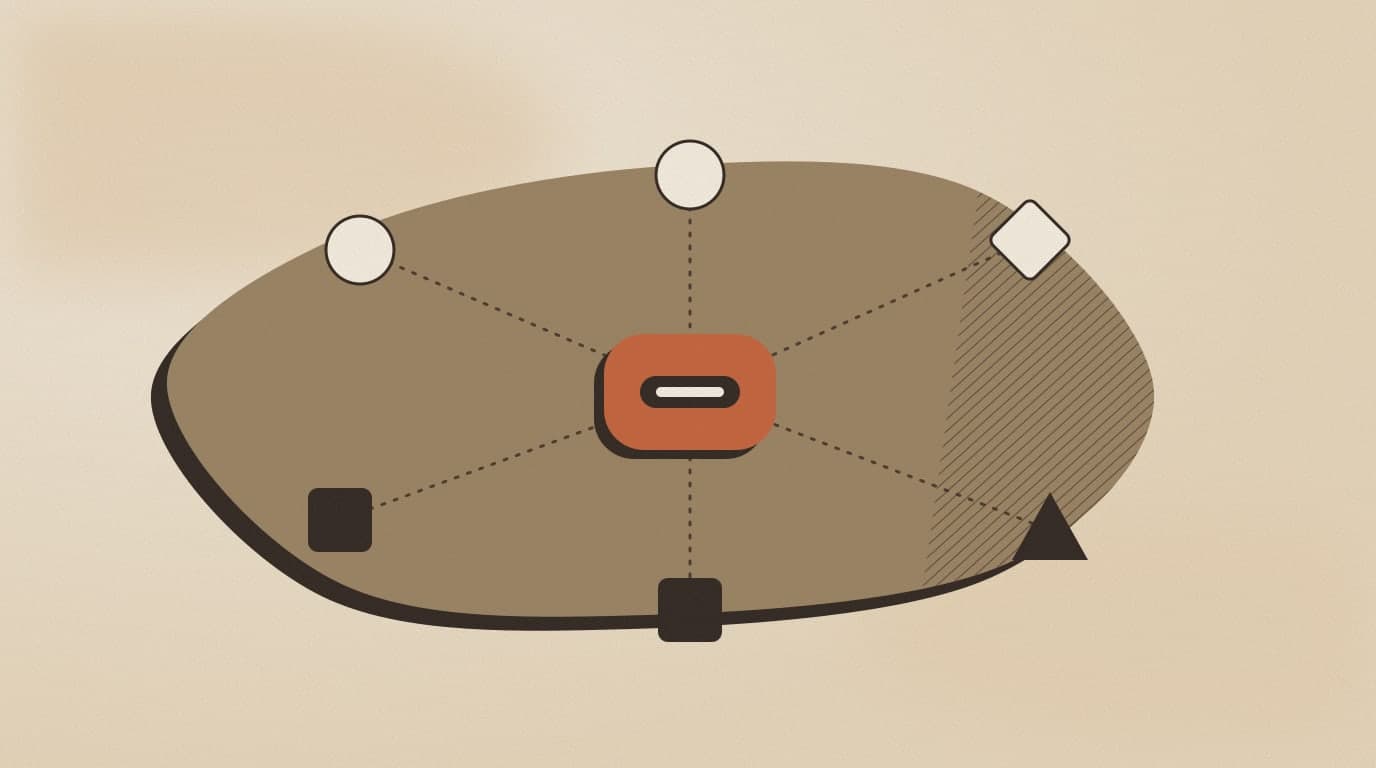

An MCP server is a small piece of software that connects an AI model to an external system - a database, a CRM, a file store, an API - using the Model Context Protocol (MCP), an open standard created by Anthropic in November 2024. Instead of building a custom, fragile integration for every AI-tool combination, an MCP server exposes a system's capabilities in a standard format that any MCP-compatible AI can use.
MCP Server Meaning: The USB-C Analogy#
Before USB-C, every device had its own charger and cable. Before MCP, every AI integration was its own bespoke project: connecting a model to Salesforce was one codebase, to Slack another, to your internal database a third - and switching AI providers meant rebuilding all of them.
The Model Context Protocol standardises that connection. An MCP server publishes three things about a system:
- Tools - actions the AI can take ("create a ticket", "run this query", "send this email")
- Resources - data the AI can read (documents, records, file contents)
- Prompts - reusable task templates the system offers
Any MCP-compatible client - Claude, ChatGPT, AI-powered IDEs, or a custom AI agent - can then discover and use those capabilities without custom glue code. Since its release, MCP has been adopted well beyond Anthropic, including by OpenAI and Google DeepMind, making it the de facto standard for connecting AI to tools.
How an MCP Server Works, Step by Step#
- The AI receives a task - say, "summarise yesterday's new support tickets and post the summary to Slack."
- The client lists available tools from connected MCP servers: a helpdesk server exposing
search_tickets, a Slack server exposingsend_message. - The model calls the tools it needs - first
search_ticketswith yesterday's date range, thensend_messagewith the drafted summary. - Each MCP server executes the request against the real system, applying its own authentication and permissions, and returns structured results.
- The model composes the outcome and reports back - or continues with further steps if the task requires them.
The crucial detail: the AI never gets raw credentials to your systems. The MCP server is the gatekeeper - it decides what is exposed, enforces permissions, and logs every call. Done properly, this makes AI access more auditable than a human with a password.
MCP Server Examples#
The ecosystem now covers thousands of servers. The ones we see most in business deployments:
| MCP Server | What It Lets AI Do |
|---|---|
| GitHub / GitLab | Read code, review pull requests, manage issues |
| Slack | Read channels, post messages, manage threads |
| Jira / Atlassian | Search, create, and update tickets and docs |
| Google Drive | Search and read documents and spreadsheets |
| Postgres / MongoDB | Query business data with controlled access |
| Playwright | Drive a browser - testing, scraping, form-filling |
| Custom internal servers | Your CRM, ERP, booking system, or proprietary API |
That last row is where the business value concentrates. Off-the-shelf servers cover mainstream tools; a custom MCP server exposes your systems - the internal API, the legacy database, the industry-specific platform - to every AI agent you deploy. That's the core of our MCP integration service.
Why MCP Servers Matter for Business#
Build once, use everywhere. One MCP server for your order system serves your support agent, your finance agent, and your reporting agent alike - and survives a switch of AI provider.
Security by design. Permissions live in the server, not the prompt. You decide the AI can read invoices but not void them, query customers but not export the table. Every action is logged.
The foundation for agents. Agentic AI is only as capable as the tools it can reach. MCP is how those tools become reachable - which is why serious AI agent deployments start with the integration layer, not the model.
Future-proofing. With MCP adopted across the industry, the integration work you do today keeps its value as models improve. Better models slot into the same servers and simply use them more capably.
Do You Need a Custom MCP Server?#
Use this quick test:
- Your AI use case needs data that lives in your systems, not public ones → yes
- An off-the-shelf server exists for your exact tool and permission needs → use that instead
- You want multiple agents sharing one governed connection to a system → yes
- You're only using AI for standalone content generation → not yet
A typical custom MCP server takes 2-4 weeks to build and deploy, including authentication, permission design, and audit logging. If you want a concrete scope for your stack, book a free demo and we'll map your systems to the agent use cases they unlock.
Frequently Asked Questions#
What does MCP stand for?#
MCP stands for Model Context Protocol - an open standard for connecting AI models to external tools, data sources, and systems. It was created by Anthropic and released in November 2024, and has since been adopted across the AI industry.
Is an MCP server the same as an API?#
No. An API is how software talks to a specific system, and every API is different. An MCP server wraps a system (usually via its API) and presents it in the one standard format AI models understand - including the tool descriptions the model reads to know what it can do and when to do it.
Are MCP servers safe?#
The protocol itself is neutral; safety comes from implementation. A well-built MCP server enforces least-privilege permissions, authenticates every call, keeps humans in the loop for consequential actions, and logs everything. That's engineering work - and the main reason production servers differ from weekend demos.
Can non-technical businesses use MCP?#
Yes - that's rather the point. Your team interacts with an AI assistant or agent in plain English; MCP servers do the technical work invisibly underneath. The build requires engineering, but the daily use doesn't.
MCP turned AI integration from a per-project problem into reusable infrastructure. If you want your systems agent-ready, our MCP integration service designs, builds, and secures custom servers for UK businesses - from first scoping call to production in 2-4 weeks.

AI engineer at BrightBit Digital